![How Much Does a Website Cost in 2026? A Full Breakdown]
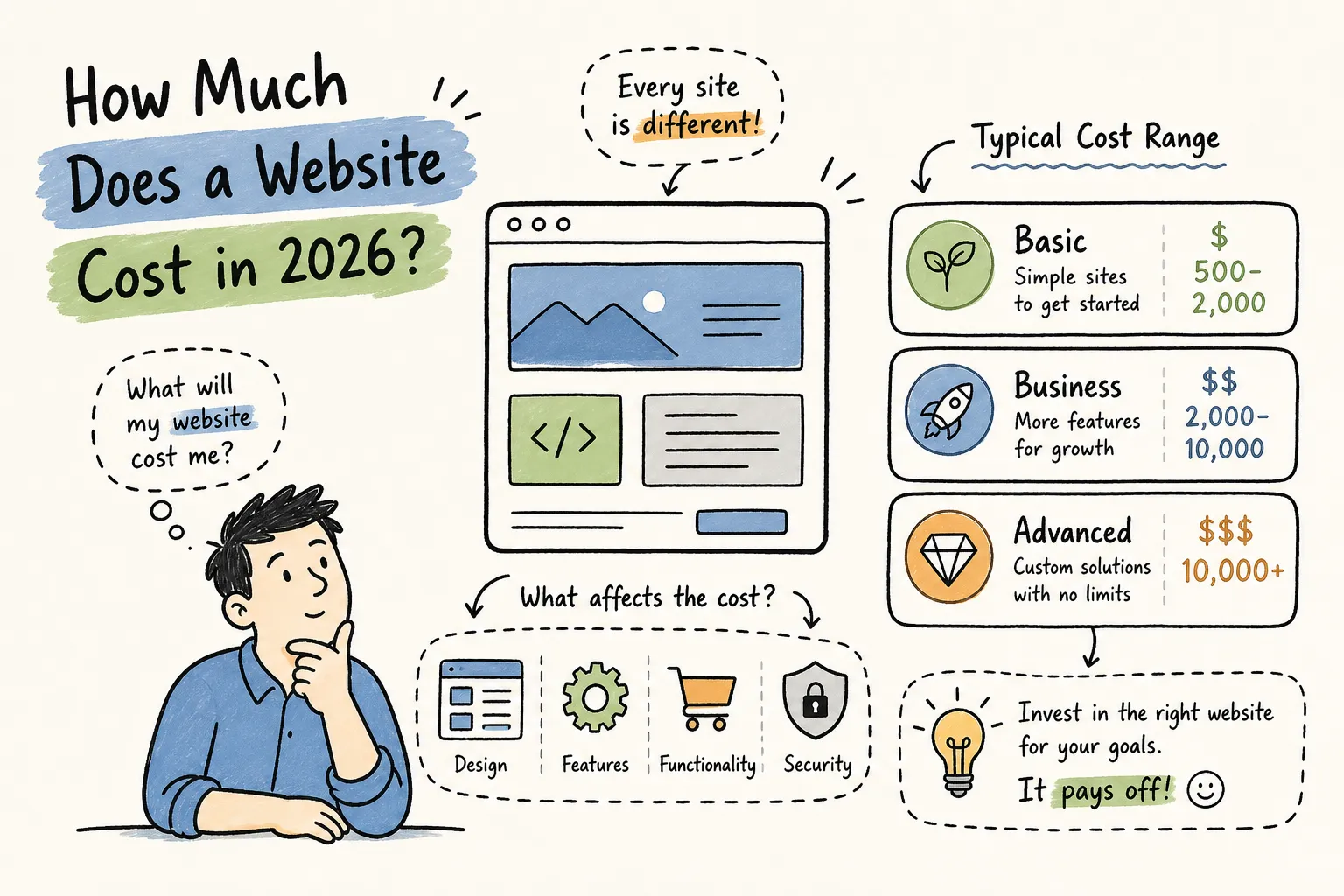
How much does a website cost? Most businesses receive quotes somewhere between $500 and $50,000, with zero explanation for the gap. To be more precise: a simple one-page site typically runs $500, $3,000, a small business site with five to ten pages lands between $2,000 and $8,000, an e-commerce build ranges from $8,000 to $40,000 or more, and custom web applications start at $15,000, $30,000 minimum. That wide overall range tells you nothing useful about your specific situation, and it makes budgeting nearly impossible.
This guide breaks down real 2026 pricing by build type, site scope, and business need. It covers one-time build costs, recurring fees, and the line items most agencies skip until after you've signed. At FenixL, walking clients through real pricing scenarios before any scoping call is a core part of how we work. That approach starts here. By the end, you'll know what to budget, what to watch for, and which build approach fits your goals.
What actually drives website costs up or down
Before looking at specific numbers, you need to understand the three variables that control price. Consider a quote without this context: it's just a number with no meaning, and no way to evaluate whether it's fair for your project.
The scope of your site
Page count, features, and design complexity are the biggest cost drivers. A five-page brochure site with a contact form is a fundamentally different build from a 30-page site with a client portal, booking system, and member login. They're not different sizes of the same thing. They're different products. The more custom functionality your site requires, the more hours go into building it, and the higher the price.
Who you hire to build it
Three options sit at very different price points: building it yourself on a website builder, hiring a freelance designer or developer, or working with a full-service web development agency. Each comes with different trade-offs in cost, speed, quality, and how much control you retain over the final product. The full breakdown of each path is in the next section.
Platform and technology choice
The platform your site is built on affects both the upfront build cost and your total cost of ownership over time. WordPress, Shopify, Wix, Squarespace, and custom development each carry different long-term maintenance implications and scaling limitations. Cheaper to build on doesn't always mean cheaper to own two years from now.
How much does a website cost by build type in 2026
These are U.S. market ranges drawn from current platform pricing and industry rate data. Use them as planning benchmarks, not hard quotes.
DIY builders: Wix, Squarespace, and Shopify
These platforms bundle hosting into their subscription pricing, so there's no large upfront build fee. Wix Core runs $29/month billed annually ($36/month on monthly billing). Squarespace Basic is $16/month annually ($25/month monthly). Shopify Basic is $29/month annually ($39/month monthly). Add a domain at $10, $25/year and your primary cost is the ongoing subscription plus your own time. This path works for very early-stage businesses, simple portfolios, or testing a concept before investing further. The trade-off: you hit customization ceilings quickly, and building it yourself isn't free when your time has value.
Freelancer-built sites
Freelance web designers in the U.S. typically charge $50, $150/hour, with senior specialists reaching $150, $250/hour. For a standard small business site, project prices run $1,500, $8,000. More polished custom work from an experienced freelancer lands between $3,500 and $18,000. This is the most common starting point for small businesses with budgets under $10,000. Quality varies significantly between freelancers, so vetting their portfolio carefully matters more here than with an established agency, the question checklist further below applies especially in this case.
Agency builds and custom web development
Full-service web agencies in the U.S. charge $100, $150/hour on average, with senior specialists running $120, $250/hour. Project prices start around $5,000 for smaller agency engagements and scale to $30,000 or more for custom builds. Custom web applications with user accounts, dashboards, and complex integrations start at $15,000, $30,000 minimum. Agencies bring structure, project management, and accountability, and you're paying for all of that in addition to the actual build hours.
How much does a website cost to maintain: recurring fees to budget
Most budget conversations focus entirely on the one-time build cost. That's the wrong frame. Your website carries a total annual cost that continues regardless of who built it or what you paid upfront.
Hosting, domain, and SSL
Shared hosting runs $3, $25/month ($36, $300/year). Managed WordPress hosting, which is more appropriate for a business site with real traffic, runs $25, $100/month ($300, $1,200/year). Domain registration is $10, $25/year for standard extensions. SSL certificates are free through most modern hosts via Let's Encrypt, so budget $0 here unless you need advanced validation. A realistic all-in infrastructure cost for a basic WordPress site sits between $150 and $600 per year, depending on whether you use low-cost shared hosting or a managed WordPress environment.
Platform subscriptions and ongoing maintenance
If you build on Wix, Squarespace, or Shopify, the annual platform fee is a permanent line item in your budget. For self-hosted WordPress sites, annual maintenance covering updates, backups, security monitoring, and light content edits runs $600, $3,600/year for a small business. More hands-on professional management runs $3,600, $9,600/year. Many first-time website owners later discover these recurring costs hadn't made it into their original budget, especially once they realize the site doesn't maintain itself and the developer who built it charges hourly for every change.
Hidden fees that inflate your real website cost
These are the line items that routinely appear in invoices but almost never appear in initial quotes. Knowing them upfront means fewer surprises after you've committed to a budget. Now that the full cost picture is in view, here is what those numbers look like assembled into real project scenarios.
Payment gateway and transaction fees
If your site accepts online payments, processing fees are a permanent recurring cost. Stripe and similar gateways charge 2.9% + $0.30 per transaction as the U.S. baseline. Some platforms add their own fee on top if you use a third-party gateway. Shopify, for example, charges an additional transaction fee ranging from 0.2% to 2% depending on your plan when using a third-party gateway, that fee disappears only if you use Shopify Payments. On a $10,000/month revenue store, that's a real dollar amount every single month, not a rounding error.
Plugin and app subscriptions
Most WordPress sites rely on a stack of premium plugins for SEO, security, forms, caching, and performance. Each one individually costs $5, $100/month or $20, $500/year. A typical small business plugin stack for SEO ($60, $150/year), security ($100, $200/year), forms ($50, $200/year), and caching ($50, $60/year) adds $260, $610/year in recurring fees. None of that appears in a standard build quote.
Content, copywriting, and SEO setup
The build cost almost never includes writing the actual copy for your pages, sourcing photography, or any SEO optimization work. Professional copywriting for a 5, 10 page small business site adds $1,500, $5,000 to your budget, with mid-market projects typically landing around $2,000, $4,000. SEO setup covering schema markup, keyword mapping, and page optimization adds another $500, $2,000 depending on depth. These aren't optional extras for a site that needs to generate leads. A technically sound site with weak copy and no SEO foundation won't perform.
Real-world website budget examples for three business types
These scenarios give you concrete numbers you can use when building a budget or evaluating a quote.
Local service business (5, 10 pages, no e-commerce)
Think: a plumber, consultant, law firm, or local restaurant. A realistic 2026 first-year budget breaks down to a freelancer build at $3,000, $6,000, hosting and domain at $200, $400/year, basic maintenance at $600, $1,200/year, and a foundational SEO setup at $500, $1,000 one-time. Total first-year cost: approximately $4,300, $8,600. From year two onward, ongoing annual costs run $800, $1,600 for hosting and maintenance.
Small e-commerce store
Think: a boutique retailer or product-based brand with 50, 200 SKUs on Shopify or WooCommerce. Budget for an agency or experienced freelancer build at $8,000, $20,000, a Shopify Basic subscription at roughly $348/year billed annually, payment processing at 2.9% + $0.30 per transaction ongoing, and apps or plugins at $200, $600/year. Total first-year cost: approximately $10,000, $23,000. Year two and beyond runs $1,500, $3,500/year depending on revenue volume and your app stack.
Startup or early-stage SaaS MVP
Think: a founder who needs user accounts, a dashboard, and API integrations with third-party services. Custom development starts at $15,000, $30,000 minimum. Add managed hosting at $1,200/year and an ongoing development retainer for updates and bug fixes at $2,000, $6,000/year. Total first-year cost: $18,000, $37,000 or more. This is the range where cutting corners on the initial build creates expensive technical debt that costs more to fix than it would have cost to build correctly the first time.
How to get an accurate quote before you commit
Armed with realistic ranges, your next step is getting quotes that actually reflect your project. Most quotes fall short because the right questions weren't asked upfront.
Questions to ask any developer or agency
Before signing anything, work through this checklist:
- Written scope and line-item breakdown: Ask for a document that separates what is included from what is not, no bundled totals.
- Technology stack rationale: Ask which platform they'll use and why it fits your specific needs, not just their workflow.
- Code and file ownership: Confirm who owns the site files and code when the project ends.
- Post-launch maintenance plan: Ask what ongoing support looks like and what it costs.
- Scope of the quote: Verify whether content, copywriting, SEO, and third-party integrations are included or excluded.
Any developer or agency worth working with answers these questions clearly and without hesitation. Vague answers to direct questions are a meaningful signal.
What transparent website pricing actually looks like
A legitimate quote separates build costs, hosting, maintenance, and add-ons into distinct line items rather than bundling everything into one number. At FenixL, this is exactly how we work with new clients: real-number breakdowns with no buried fees, so business owners can make a confident decision with full visibility on what they're committing to. If a quote you receive doesn't address the questions above, ask for a revised version before you proceed. A good agency expects that request and won't flinch at it.
Build your budget with real numbers, not guesses
How much does a website cost in 2026? The honest answer depends entirely on what you're building. A DIY builder subscription runs roughly $192, $348/year depending on the platform and plan. A freelancer-built small business site typically lands between $4,000 and $9,000 in year one, which falls within the broader $1,500, $18,000 range depending on complexity and the freelancer's experience level. A custom e-commerce build or SaaS MVP can easily exceed $20,000 before the first year is out.
The one-time build cost is only part of what a website actually costs per year. Hosting, maintenance, platform subscriptions, plugin stacks, payment processing, and content all belong in your planning budget from day one, not as surprises after launch. Use the sample budgets above and the question checklist to evaluate quotes against real benchmarks rather than accepting a number with no context.
If you're still unsure which build approach fits your goals and budget, the team at FenixL offers no-pressure consulting sessions focused on helping you figure that out before you spend a dollar. Get in touch and we'll work through the numbers with you.